
 When conducting an outbound marketing or lead generation campaign, choosing between branded promotional products and printed collateral (such as brochures, direct mailers, or flyers) can be difficult.
Both are considered giveaways, and both consume a considerable amount of the marketing budget. While both can be effective, each has a specific role in the sales funnel and are treated very differently by those with purchasing authority. Ultimately, the decision on which to use comes down to how you want prospects to experience your brand—tangible utility vs. informational clarity.
Let’s explore the various pros and cons of print vs. promo and help clarify where one might be superior to the other.
Perception
As a marketing giveaway, promotional merchandise is generally more effective than printed collateral because it creates a lasting, tangible connection with the recipient.
Promotional products are seen as a gift—not informational, but something the recipient wants. Useful, well-designed items tend to be kept, used, and seen repeatedly, extending brand exposure far beyond the initial interaction. They also carry a sense of value, which can trigger a subtle reciprocity effect and make prospects more receptive to future appeals. At events like trade shows or as direct outreach to targeted accounts, this “stickiness” gives merchandise a clear advantage.
Printed collateral, by contrast, is seen as more of an informational tool, not as a gift that someone wants to receive. While it can communicate a clear call to action, it is often seen as a task to read, consumed quickly and discarded unless the information it contains is immediately relevant or compelling to the consumer. As a standalone giveaway, it rarely has the same impact or longevity as a physical item with utility. In fact, a printed item could be considered an environmental liability, prompting many companies to stay away from it or to use more sustainable options like recycled paper.
Ultimately, the decision comes down to purpose. If the goal is to be remembered and create a positive impression, branded promotional merchandise is typically the better choice. If the goal is to educate or drive a specific action, printed collateral performs better as a supporting piece rather than the giveaway itself.

Lifespan
Another barometer of success is lifespan: how long does the recipient keep the item?
The very nature of printed material is to be informative and impart timely information or specifications, but its destiny is to eventually be tossed. Printed collateral usually does not last long after the customer has read it and internalized the contents.
Promotional products are meant to last, but they do not convey much information—they are merely intended to help recipients remember your company and logo. People tend to hold on to promotional products, especially when they are useful or of high quality. That’s great for brand recall, but beyond that, they don’t do much to tell the holder what your company really stands for.
Industries
While all industries use a mix of both branded promotional materials and printed collateral, some do restrict what they can give to the end user to avoid the appearance of impropriety.
For instance, printed material is the most common giveaway for businesses associated with the medical field. This is primarily because of its informative nature, but also because there are rules against giving “gifts” to doctors’ offices.
Any industry with strict guidelines about receiving giveaways—including the government—tend to be huge consumers of printed material. Branded promotional products are given mainly to employees or used for internal purposes only. 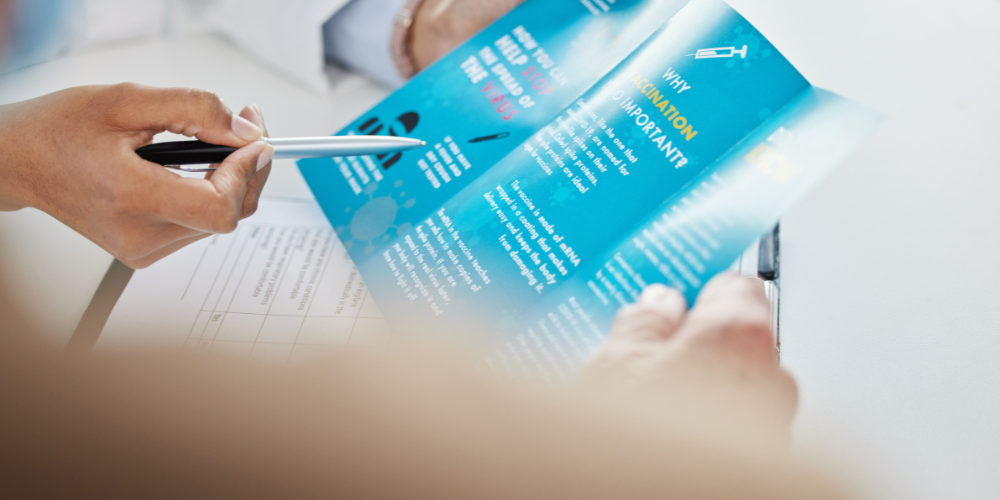
Order Quantities
Print generates higher order quantities since it is usually given and tossed once read. It’s not unusual for tech companies to order tens of thousands of a brochure or flyer to be printed so they can hand out a couple hundred to doctors’ offices or clinics. The rationale is that, provided the information within is not dated, the same items can be used for literally scores of other uses in the future, and it’s always cheaper to print more than you need than go back for a second print run.
Promotional items, on the other hand, are generally ordered in smaller quantities since they have a longer lifespan, and only one is given out at a time. However, it’s important to understand that order quantities for promotional products vary widely. Orders for relatively low-cost branded pens and stress balls typically number in the thousands since they are handed out by the fistful at events like trade shows. Conversely, orders for high-end executive gifts might number in single digits.
Price
Printed material tends to cost less to manufacture than promotional merchandise, depending on the quantities, paper quality, and binding options. While the price will vary, it’s extremely rare to see a print job that exceeds $20 per piece, and that is usually an elaborate periodical with multiple pages, high-end binding, and other special touches.
Promotional items have an extremely wide price range, from simple giveaways priced under $1 each to luxury gifts that cost more than $500. It’s safe to say there is branded merchandise for every budget, with the average being around $25 per piece.
Artwork
Generally speaking, printed collateral is more demanding than promotional merchandise when it comes to the artwork required. Digital or offset printing requires extremely tight, specific specifications and vector-quality artwork. Since printed material is by definition is text heavy and/or has detailed imagery, there are not many workable options outside of digital and offset printing.
The artwork used for promotional items can be somewhat complicated, but most companies just stick with their corporate logo on the product. The logo can be imprinted in various ways depending on the product or material (screen print, heat transfer, laser, embroidery, emboss, deboss, patch, etc.). As long as the logo is vector-based, it will look great.
Some promotional items can be fully customized, but this usually does not include heavy text or images, more intricate patterns, or other visual graphic designs to complement their logo.
The Final Analysis
When should you use branded promotional merchandise and when will printed material do the job?
As a rule of thumb, use promotional merchandise when the primary goal is to attract attention, build goodwill, or open doors that might otherwise be closed. Physical branded gifts work best in situations where the audience is small, well-defined, and potentially valuable enough to justify a higher cost per contact. This includes, but is not limited to, account-based marketing, executive outreach, post-meeting follow-ups, and, in rare cases, events where you really want to stand out in a crowded market. Promotional merchandise is especially effective early in the relationship or when trying to re-engage stalled opportunities, because it creates a sense of reciprocity and gives your brand a physical presence that lingers over time.
Use print when the goal is to communicate clearly, deliver a specific message, or drive a defined action at scale. Print offers a more effective way to explain your offering, highlight differentiators, present offers, or guide prospects to a desired next step such as visiting a landing page, requesting a demo, or attending an event. Print also works well in broader outbound campaigns, direct mail programs, and lead nurturing efforts where cost efficiency and reach matter. Finally, print plays a critical role later in the funnel when prospects are evaluating options and need detailed information to make a decision.
In the final analysis, the decision really comes down to two things: intent and audience. If you want to create a memorable first impression, promotional merchandise is the stronger lever; if you’re trying to inform, persuade, and convert across a larger audience, print is more practical and effective.