
The most common question we get from customers seeking branded promotional merchandise is whether we have access to the same well-known retail brands, products, and apparel as their other promotional distributors.
The short answer is yes.
The longer answer requires an explanation of how the promotional industry actually works. In this blog we will dissect the product chain and show that OnFulfillment has access to all the same materials as any other branded promotional vendor. 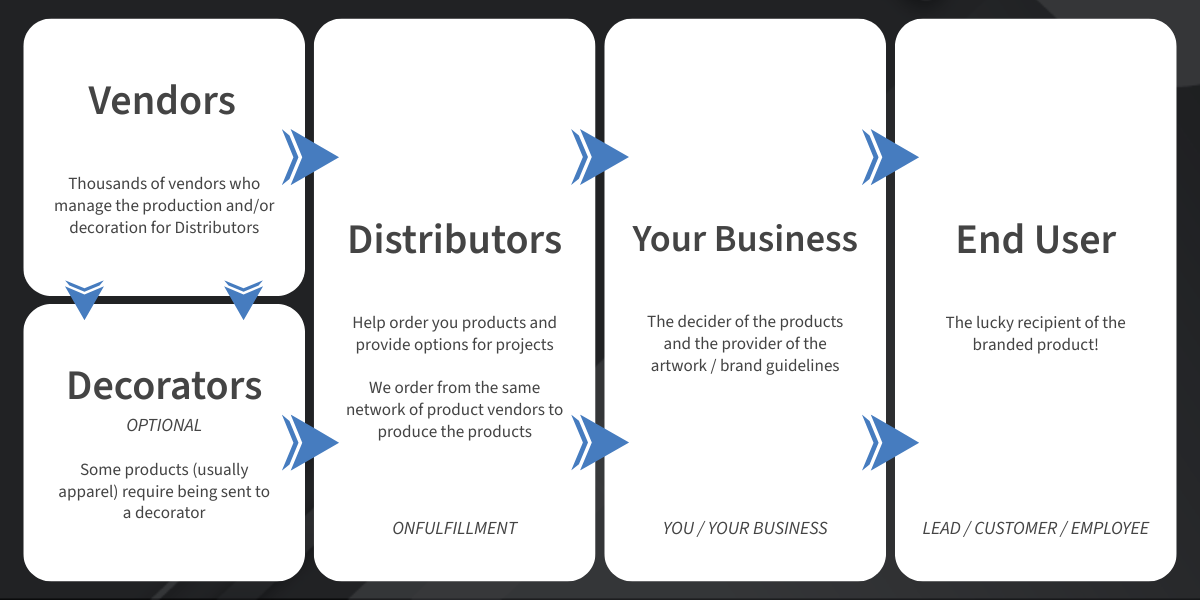
Breaking Down the Industry
The following infographic provides an overview of how the product chain works. Essentially, it reveals that products begin with vendors, some of whom customize products themselves while others outsource that function to decorators. The finished products are forwarded to distributors, who manage the relationship between your business and the vendors/decorators. Ultimately the products end up in the hands of users, whether employees, customers, or prospects.
We explain each step and their associated players in the text below.
Vendors
In the language of the promotional industry, “vendors” are the companies that manufacture and decorate the products that distributors sell to their customers. Except in rare cases, these vendors do not sell directly to customers—they only sell to distributors.
Vendors are generally divided into three basic categories: hard goods (pens, water bottles, etc.); apparel/fabric-based goods (shirts, hats, backpacks); and trade show signage (banners, table throws).
In order to provide a quicker turnaround, most apparel/fabric and wearable vendors only sell blanks that need to be sent to a decorator for customization. Many of these vendors have warehouses located around the country so that blanks can be quickly delivered to local decorators.
There are many apparel/fabric-based vendors in the U.S., including AS Colour, Stormtech and Cutter & Buck. The two largest, SanMar and S&S, offer the largest and most popular retail brands like Nike, Adidas, Richardson and North Face on top of their own brands like Port Authority and Devon & Jones.
Unlike apparel/fabric-based providers, hard goods vendors decorate their own products onsite at one of their small number of warehouses or fulfillment centers. Some of these hard goods vendors have started to dabble in the apparel and trade show markets, expanding their offerings in order to provide a one-stop shop solution for distributors.
Trade show signage vendors are a bit different than the others in that they are typically a small part of, or department within, a larger print shop. This makes logistical sense since these promotional products are typically ordered in much smaller amounts—quantities that don’t justify a standalone business.
Retail Brands
Many retail brands, recognizing the significant business opportunity, have started partnering with promotional industry vendors to help them warehouse, distribute, and sometimes even decorate their corporate-branded products. These brand-name retailers sell their products through groups that have been formed to represent them, and distributors can only purchase blank or decorated name-brand promotional items through these representatives.
 These groups serve a dual purpose. Not only do they make brand-name products more accessible to the promotional distributors, they also help the retail brand companies avoid the overhead associated with bulk ordering and distribution. Since the typical promotional merchandise order is usually in the hundreds or even thousands of pieces, the retailers know they can sell their products to these groups at a steep discount and still make a profit thanks to the large quantities.
Some retail brands have even started creating pieces specifically for the promotional industry, allowing them to ensure their own brand is respected by appearing in a desirable spot. For example, with promotional apparel, the corporate logo typically appears on the left chest area. By designing apparel for promotional purposes, retail brands can leave the left chest imprint area open while placing their logo in a prominent spot like the sleeve or the hem, ensuring equal visibility for their brand.
Some better-known retail brands like North Face, Patagonia, and Nike have placement and decoration restrictions that limit customers’ branding options. These retailers also have the right to forbid their products from being used by companies in certain industries they don’t want to be associated with, such as tobacco.
Decorators
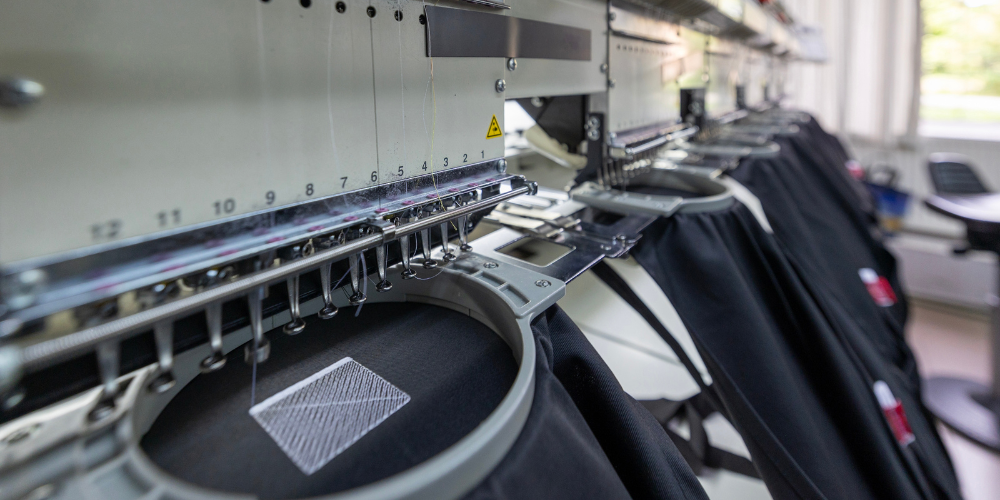
While not always necessary since some vendors handle their own customization, decorators are critical for applying corporate logos to merchandise such as apparel. Decorators are available throughout the U.S. and are often selected based on how much they can reduce shipping charges and turn times.
Distributors will normally choose a decorator as close as possible to the order’s final destination, whether a fulfillment warehouse, office building, or event, in order to secure the shortest transit times and lowest freight costs.
Apparel vendors maintain a network of decorators that are close to their production facilities and warehouses to minimize shipping and accelerate delivery times for their customers.
Most decorators offer basic services such as screenprint and embroidery, while others specialize in quick turnarounds and unique fabric methods such as heat transfer, laser, debossing or patches.
Distributors
Distributors act as a filter for customers of the promotional industry and are who
With so many options available, the consumers of branded promotional merchandise need help sorting it all out and finding the best deal. Distributors whittle down the products their customers are shown for a specific project to find the best fit based on relevance, pricing, and quality.
All distributors have access to the same network of vendors and brands, particularly if they are members of professional organizations such as Professional Products Association International (PPAI) and/or the Advertising Specialty Institute (ASI). PPAI, the group that most vendors and distributors belong to, offer members resources for education, industry updates, and networking. For distributors, this provides access to the largest network of vendors to ensure the best discounted pricing.
The distributor you choose should make your life easier. A good distributor acts as an extension of your branding/marketing team by knowing the culture and understanding what products work best you’re your company’s branding and budget. If you only need branded products, there are plenty of distributors who offer the same products and can ship directly to your office or event. If you’re looking for additional services, like warehousing or stocking online stores, distributors like OnFulfillment are a better fit.
A lot of vendors maintain tiered pricing systems designed to reward large-volume distributors like OnFulfillment with better pricing and benefits like free shipping, no set-up costs, and sponsoring sample programs. Additionally, OnFulfillment belongs to several buying groups that ensure even lower pricing and other benefits from the top vendors in the world—benefits that are passed on to customers.
Your Company, Your End Users
Whether the products you order from your distributor are for employees, customers, or prospects, the important message here is that you get to decide what works best for your brand.
The promotional products you give out are a direct reflection of your brand. When people see your logo on a product, they associate your brand with that product. The higher the quality, the better the impression.
Having a trusted partner who can help you find the right product at the right time for the right event is critical. A partner who can also offer additional services such as shipping and warehousing your products before and after these events is even better.
OnFulfillment has access to the same promotional product vendors as everyone else and will also warehouse, manage, and ship your products so you always know exactly how much inventory you have. As a partner staffed by professionals, we also know exactly what products you tend to order, which run out the fastest to keep inventory well stocked, and which new products will work best with your brand.
Want to learn more about what OnFulfillment can do with your branded promotional merchandise?